The Street That Predates America: A Complete Guide to Aviles Street in St. Augustine
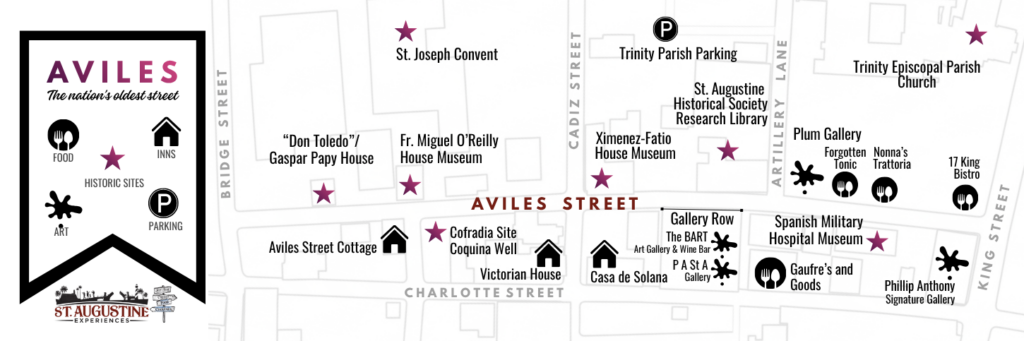
Most people arrive in St. Augustine having done some basic research. They’ve seen photos of the Castillo. They booked a hop-on hop-off trolley. They know St. George Street is where to shop. They understand, in a general way, that this city is old.
Most visitors to St. Augustine walk right past Aviles Street.
That is not a criticism. It is just the reality of how this city’s foot traffic flows. Most people turn onto St. George Street, cross toward the Plaza de la Constitución, or follow the crowd down King Street without ever glancing down what appears to be a narrow side corridor that doesn’t immediately reveal what it holds. The first businesses are nearly 150 feet in from the entrance. There is no sign at the gateway telling you what’s down there. And so most people don’t go.
I’ve walked this street thousands of times, and I still think about all the people who don’t.
I’ve stood at its northern entrance, a coquina pillar gateway with a wooden crossbeam that has seen better days, and watched first-time visitors stop, peer down the corridor, maybe snap a photo under the arch, and then turn back toward King Street and keep walking. They have no idea what they just passed. They don’t know about the galleries, the museums, the tavern built on a seized royal estate, the research library in a house where a Confederate general was born, or the markers on the pavement showing where the walls of the first Catholic church in America once stood.
They don’t know they just walked past the oldest street in the United States.
That is exactly why I’m writing this. Consider this your sign.
The Oldest Street in the United States
Aviles Street is the oldest platted street in the United States. Not one of the oldest. The oldest.
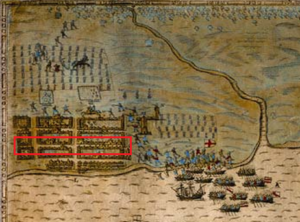
The earliest visual record most historians point to is the Boazio map, drawn in the aftermath of Sir Francis Drake’s 1586 raid on the city. Aviles Street is there, already part of an established corridor in a functioning colonial town. Some researchers believe it appeared on even earlier Spanish maps dating as far back as 1572, which aligns with what we know about the city’s own evolution. Pedro Menéndez de Avilés founded St. Augustine on September 8, 1565, but the original settlement was located in a slightly different spot. The town relocated to its current position around 1572, which may explain why evidence of this street begins appearing around that same time. The formal street grid we recognize today came later still. Spain’s Law of the Indies, which codified the plaza-centered grid design used in colonial cities across the Spanish empire, wasn’t issued until 1573. St. Augustine’s current grid layout wasn’t fully designed and implemented until 1598. So the street we now call Aviles predates even the formal urban plan it eventually became part of. A corridor that existed before the city around it was fully organized and has outlasted every version of that city ever since.
To put Aviles Street’s age in perspective, it predates:
- Jamestown (1607)
- Plymouth (1620)
- New York City (1624)
- Boston (1630)
- Charleston (1670)
- Philadelphia (1682)
- New Orleans (1718)
- Savannah (1733)
…and every other surviving street in the country.
A quick note worth making here, because it comes up often: the brick paving you walk on today is not colonial-era. Like most streets in St. Augustine, Aviles was a dirt, sand, and oyster shell road for most of its life and wasn’t bricked until the early 20th century. The bricks are a relatively recent addition. The street beneath them is not.
The history of this corridor became even more extraordinary when city archaeologist Carl Halbirt and his team broke ground on Aviles Street itself during a revitalization project in 2010. Excavating beneath the sidewalk, they discovered post holes indicating a large structure, pottery shards dating to the 1500s, and human remains, evidence pointing to the western wall of Nuestra Señora de los Remedios, the first documented Catholic parish church in what is now the United States. The church flourished from 1572 until 1702, when it was destroyed during a British attack, and was eventually forgotten beneath the city that grew over it.
Then in 2017, working in conjunction with PBS on a documentary, Halbirt’s team excavated the Fiesta Mall building at the corner of King Street and Charlotte Street, just steps from Aviles. What they found there stopped everyone cold. More than twenty burials of what are believed to be some of St. Augustine’s earliest colonists, dating to between 1572 and 1586, just years after the city was founded. Men, women, and children. Africans and Europeans, buried side by side in the Christian tradition, arms folded, heads to the east. Together, the two digs confirmed what archaeologists had long suspected, that the ground in and around Aviles Street holds the physical remains of America’s earliest colonial community.
Halbirt called the discovery “probably just as significant as the Castillo de San Marcos.” The Smithsonian covered it. It made national news. The bones of the people who built this city, who walked this street when it was still a dirt path through a Spanish colonial outpost, are still here, just beneath the surface.
Pottery shards tell you a street is old. Burials tell you it was home.
In 2026, the United States celebrates 250 years of independence. St. Augustine turns 461. Aviles Street has been here for nearly all of it. Through every flag that has flown over this city, through Drake’s raid, through four different governing powers, through the full arc of American history. When the country throws its biggest birthday party this July 4th, the oldest street in the nation will have been standing for nearly twice as long.
Let that land for a moment.
From Hospital Street to Aviles Street
For most of its history, this street had a different name entirely.
It was called Hospital Street, because it ran directly through St. Augustine’s colonial Spanish military hospital complex, a three-part facility that treated soldiers and settlers hundreds of miles from the nearest major Spanish outpost. The physicians and surgeons who worked here adapted constantly, practicing medicine at the edge of a new world with limited supplies and no safety net. Their patients were soldiers, sailors, and settlers trying to hold a city together in a place that tested them at every turn.
Today, the Spanish Military Hospital Museum at 3 Aviles Street tells that story. The current structure is a careful reconstruction as the originals did not survive, but the history it preserves is very real, and the guided tours here cover colonial medical practices, surgical demonstrations, and an apothecary that will make you genuinely grateful for modern medicine. It is one of the most underrated experiences in this city.
The street officially became “Aviles Street” in 1924, renamed in honor of Avilés, Spain, the hometown of our city’s founder Pedro Menéndez de Avilés and St. Augustine’s sister city across the Atlantic. The renaming came nearly 360 years after the city’s founding, but the connection it honors is as old as the street itself.
A Street With More Stories Than Buildings
What makes Aviles Street extraordinary isn’t just its age. It’s that almost every structure on this block carries not one story but several. Centuries of use layered on top of each other like the archaeological strata beneath the pavement. The only way to do it justice is to walk it as it happened, from oldest to newest.
The Father Miguel O’Reilly House: 32 Aviles Street
This is one of the oldest structures in St. Augustine, with foundations and walls dating to 1691. Built during the First Spanish Period, when this city was still a remote frontier outpost and the rest of what would become the United States was barely a collection of struggling coastal settlements. The house has been renovated and expanded many times across the centuries and does not look exactly as it did in the 17th century. But the fact that it is still standing, still in use as a museum, still part of the daily life of this street is remarkable in itself.
The building sits within the walled property of St. Joseph’s. That surrounding coquina wall, quarried from Anastasia Island, as so much of this city’s most enduring architecture was, is itself a piece of history. I’ll return to it in the preservation section, because it recently became part of a story that would make any proponent of city preservation angry.
The Segui-Kirby Smith House: Corner of Aviles and Artillery Lane
One of only 36 surviving Spanish Colonial houses remaining in St. Augustine, and one of the most storied addresses on this street. The house dates to the late 18th century, and the site itself has been continuously occupied since the late 1500s, meaning people have lived and worked on this corner for as long as St. Augustine has existed.
In 1786, the house became the home of Bernardo Segui, a prosperous merchant of Minorcan descent who served as baker to the garrison and as a Spanish militia official. Around 1823, Judge Joseph Lee Smith, the first Judge of the Superior Court for East Florida, rented the home, and his family eventually purchased it. In May 1824, Edmund Kirby Smith was born within these walls. A West Point graduate, he would become at 38 the youngest Lieutenant General in the Confederate Army, and the last Confederate general to surrender his command at the end of the Civil War. In 1895, the property was given in trust for use as a free public library. A role it has served in one form or another ever since.
Today the St. Augustine Historical Society holds the property under that original trust and operates it as its historical research library. The collection includes maps, photographs, church records, manuscripts, and documents spanning the entire arc of the city’s history. Researchers, historians, and curious visitors are all welcome. If you want to understand St. Augustine at a depth that most visitors never reach, you walk through this door.
And if you’re joining us for our St. Augustine Food Tour, which begins just steps away on Artillery Lane, you are starting your meal and your evening within arm’s reach of one of the finest historical archives in the American South. That proximity alone says something about what kind of street this is.
The Ximenez-Fatio House: 20 Aviles Street
Built in 1798 during St. Augustine’s Second Spanish Period, this coquina stone house started its life as the home and place of business of Don Andres Ximenez, a Spanish merchant who operated a general store and billiards hall on the ground floor and lived upstairs with his family. After his death, his heirs sold the property and it transitioned into a boarding house in the early 19th century.
Three women would own and operate it in succession, each running a thriving business during an era when women holding property and managing enterprises was far from ordinary. A sign out front today reads “Women Owned Since 1821.” Our guests always stop and read it twice.
The most celebrated of those women was Louisa Fatio, who took over in the 1850s and ran what became known as “Miss Fatio’s”, St. Augustine’s most fashionable boarding house, through the Seminole Wars, Florida’s secession, and the Civil War. She hired the best people she could find, kept the house running through political upheaval and epidemic alike, and built a reputation that drew sea captains, politicians, soldiers, and adventurers from across the country. The Ximenez-Fatio House Museum is today believed to be possibly the oldest women’s history museum in the United States. If you walk past it without going inside, you are leaving one of the best experiences on this street behind.
11 Aviles Street — Where the Art District Was Born
In the 1930s, the old Hamblin Hardware warehouse at 11 Aviles Street was converted into artist studios and gallery spaces. That single conversion started something. Artists, painters, and creatives who couldn’t afford the city’s newer spaces found something better here anyway. Character, history, and a street that felt like it had been waiting for them. Aviles became St. Augustine’s first formal arts district, and that creative energy never left.
Today the building at 11 Aviles anchors the artistic identity of the street. Nine galleries, working artists, pottery studios, a map shop, and locally owned creative businesses are packed into just a few blocks. It is one of the only places in this city where Spanish colonial history and a living, working creative community genuinely coexist. Not as a performance for tourists, but as the actual texture of everyday life on the street.
4 & 6 Aviles Street — Four Centuries in One Address
Here is where the history of Aviles Street gets genuinely cinematic.
The property at this address has one of the most layered histories of any site in a city that is full of layered histories. It was once home to a royal treasurer of Spanish Florida whose estate was seized by the Crown following his death. An audit having revealed an embezzlement of staggering proportions. Over the centuries that followed, the property served as a Spanish royal hospital, a British courthouse and jail under English rule, and eventually the site of St. Augustine’s first public school.
In 1955, the block became the Ponce de Leon Shopping Center. The first downtown shopping center in St. Augustine, designed by Morris Lapidus, the architect behind the Fontainebleau Hotel in Miami Beach and one of the defining creative voices of mid-20th-century American architecture. It is the only example of his work in St. Augustine. The Woolworth’s department store anchored the complex at 33 King Street, around the corner from Aviles. A different entrance to the same building.
On July 18, 1963, sixteen young members of the St. Augustine NAACP Youth Council walked into that Woolworth’s and sat down at the Whites-only lunch counter. Each ordered a hamburger and a Coke. They were arrested. A judge offered them their freedom on one condition. Promise never to protest again. Sixteen agreed. Four refused.
Those four teenagers, JoeAnn Anderson, Audrey Nell Edwards, Willie Carl Singleton, and Samuel White, were sent to reform school rather than accept that bargain. They became known as the St. Augustine Four. Dr. Martin Luther King, Jr. called them “my warriors.” Jackie Robinson praised their courage publicly and personally. Their refusal to be silenced helped ignite the broader St. Augustine civil rights movement of 1963–1964, one that drew Dr. King himself to this city and directly contributed to the passage of the Civil Rights Act of 1964. The original Woolworth’s lunch counter is now preserved at the Lincolnville Museum. A Freedom Trail historical marker hangs on the wall outside 33 King Street today. When you walk from Aviles Street around the corner to King Street, you are walking on the same path where all of it happened.
In 2019, John Moore opened Forgotten Tonic at 6 Aviles. A tavern and bottle shop he has built into one of the most celebrated dining and cocktail destinations in northeast Florida. In 2024, John expanded by breaking through the wall into 4 Aviles, creating a new cocktail lounge and an expanded kitchen. A seized royal estate. A civil rights landmark. An award-winning tavern still writing new chapters in a building that has never stopped making history.
Where We Begin
At St. Augustine Experiences, five of our tours either begin, pass through, or end on Aviles Street. That is not a coincidence. There is no better place in this city to start a conversation about who St. Augustine is, how it got here, and why it still matters.
Our History Walking Tour begins at The BART Art Gallery and Wine Bar at 11D Aviles Street. Centrally located in the heart of the street, directly across from the Ximenez-Fatio House and the Historical Society Research Library. The name is worth a moment: take the B away and you have ART. Take the T away and you have a BAR. Owners Phil and Dee have built something incredibly special & unique here, and if you arrive a few minutes before your tour begins, they love to welcome our guests and walk them through some of the local artists whose work lines the walls. Most of these artists never thought they would be hanging in a gallery! These are works by retired police officers, local school teachers, restaurant servers, and stay at home moms. It is exactly the right way to start. Standing inside a working gallery on the oldest street in the country, surrounded by the work of living artists, about to step out into four and a half centuries of history.
Our St. Augustine Food Tour begins at Gaufre’s & Goods on Artillery Lane, a few steps off Aviles, tucked into one of those narrow side lanes that this city does so well. Owners Grace and Darek have been running one of the best-kept culinary secrets in St. Augustine for over 20 years. A handful of outdoor tables line the lane. Sit outside with a Polish lager or a Greek Assyrtiko on a warm afternoon, with the old walls of the city rising around you, and you could convince yourself you’re dining in a European alleyway somewhere. On a street this old, that feeling is entirely appropriate. The fact that the St. Augustine Historical Society Research Library is practically next door, that you could finish your first course and walk thirty feet to one of the finest colonial archives in the South, is the kind of detail that only Aviles Street can produce.
Aviles Street is also a major part of our original Historic Bar Crawl, our award winning Wine, Cocktail & Food Experience, and our newest experience the Bourbon & History Tour. We don’t want to give too much away. Half the fun is the story unfolding around you as you walk, but we will say this: if any of those three tours bring you through the door of Forgotten Tonic at 4 and 6 Aviles Street, clear your evening. John Moore and his staff have a habit of coming to find our guests personally to ask what they thought. The cocktails are award-winning for a reason, and the tavern John has built is the kind of place that earns dinner reservations before guests have even finished their first drink. On a street where history is literally beneath your feet, Forgotten Tonic is one of the places where it’s also in your glass.
Five different tours. The same street. Something new every time.
A Street Worth Fighting For
I want to be honest with you about something, because I love this street and I think you will too, and people who love something fight for it.
Aviles Street is not getting the care it deserves.
In March of 2026, engineers determined that the walls of 7 Aviles Street, built in 1885, a building that once served as a St. Augustine jail, were in danger of imminent collapse. The brick façade was buckling to the point where it posed an active danger to pedestrians. An emergency demolition permit was issued. The building sits directly across from Forgotten Tonic, steps from the Spanish Military Hospital Museum, on the oldest street in the United States. A former jail on America’s oldest street needed emergency demolition in 2026 because its walls were left to deteriorate past the point of saving. That is not a story about one bad building. That is a story about priorities.
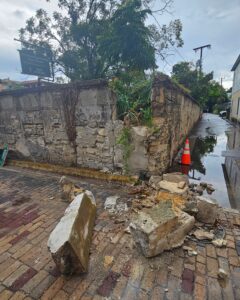
The coquina wall surrounding St. Joseph’s Convent at the corner of Aviles and Cadiz Street encloses one of the most historically significant properties on this street: the grounds of the Father O’Reilly House, with foundations dating to 1691. The wall itself is a striking example of the coquina construction that defines St. Augustine’s architectural character, and the property it protects has been part of this city’s story for centuries. Recently, an HVAC truck struck that wall and knocked a chunk of coquina clean out of it. Repairs are possible. The National Park Service has quarried coquina from Anastasia Island to tend to the Castillo de San Marcos, but it is painstaking, costly work that requires specialist knowledge and materials that are not simply sitting on a shelf somewhere. More to the point, it should never have happened in the first place. A service truck has no business clipping a coquina wall on one of the narrowest historic streets in the country. It is one more argument….a literal one, chiseled right out of the wall, for why large vehicles and Aviles Street are a combination that this city needs to take far more seriously.
The coquina pillar entryway at the north end of Aviles Street, the gateway to the oldest street in the country, has a wooden crossbeam that is showing serious signs of deterioration. It is the first thing visitors see when they turn onto this street. It is quietly telling every one of them that the city does not fully value what it has.
And then there is this: the city eliminated the First Friday Art Walk pedestrian closure on Aviles Street. It is gone. Anyone who ever experienced Aviles Street closed to traffic on a Friday evening… galleries lit and open, music drifting out of doorways, people moving freely between courtyards and restaurants without a truck bearing down on them… knows exactly what that loss feels like. Nothing disrupts the atmosphere of a street festival faster than a large vehicle squeezing through one of the narrowest historic corridors in the city. Nothing signals the wrong set of priorities more clearly than choosing vehicle access over the pedestrian experience on a street that has been walked by human beings for 450 years.
The First Friday pedestrian closure needs to come back. And it should go further. A weekly Friday evening closure that transforms Aviles Street into a regular gathering of galleries, restaurants, music, and open air culture would be one of the great recurring experiences in the American South. A monthly Aviles Street block party, the kind of event that lets locals and visitors experience this history, culture, and flavor the way people have experienced this street for four centuries, on foot, at a human pace, in each other’s company, is not an unrealistic ask. It is the obvious next step for a street that already has everything it needs to make it happen. It just needs the city to get out of the way and let it.
Aviles Street survived Sir Francis Drake’s raid in 1586. It survived fires, hurricanes, yellow fever, five flags, and the entire arc of American history. It should not lose buildings, walls, and its own pedestrian identity to neglect and short-sightedness in the 21st century, and certainly not during a year when the country is celebrating 250 years of independence on a street that has been here for nearly twice that long.
Come Walk It
In just a few short blocks, Aviles Street contains three museums, a historic research library, nine art galleries, four inns, four restaurants, a wedding venue, and an ice cream shop. It has more history, culture, and flavor per square foot than any other street in St. Augustine, and St. Augustine is already the most historically concentrated city in the country.
This year, as America celebrates 250 years, there is no better time to walk a street that watched it all unfold from the very beginning. Long before there was a Declaration to sign, long before there was a flag to raise, long before anyone could have imagined what this small Spanish colonial corridor would one day hold.
Walk slowly. Look up at the coquina walls and the colorful courtyards behind open gates. Step into the galleries. Have a cocktail at the tavern built on a seized royal estate. Let the story of the St. Augustine Four sink in when you round the corner onto King Street. Stop at the markers on the pavement and think about what lies beneath them.
My motto in St. Augustine, the one I carry into every tour, every conversation, every block I turn onto, is this:
Walk Everywhere. Talk to Everyone. Eat Everything in Between.
Aviles Street is the perfect place to start.
St. Augustine Experiences offers five tours that feature Aviles Street. Our History Walking Tour, Food Tour, Historic Bar Crawl, Wine, Cocktail & Food Experience, and Bourbon & History Tour.